

Welcome to NexusLIMS!
The project serves as the development and documentation space for the back-end of the Nexus Microscopy Facility Laboratory Information Management System (LIMS), developed by the NIST Office of Data and Informatics. This documentation contains a number of pages that detail the processes by which NexusLIMS harvests and combines data from multiple sources to build a record of an experiment on a Nexus facility microscope.
Documentation overview
The data security page explains the approach to our highest priority, which is protecting users' research data. Besides this, there are pages describing how data about individual sessions is collected and stored, as well as a detailed description of how a record of a given experiment is built, from beginning to end. There is also additional documentation about the practices used in developing NexusLIMS, the taxonomy used when discussing NexusLIMS, the schema used to represent Experiment records, and customizations that were made to the CDCS platform to create the NexusLIMS front-end. Finally, there is detailed API documentation for every method used in the NexusLIMS back-end.
Most typical users will have no reason to interact with the NexusLIMS back-end directly, since it operates completely automatically and builds experimental records without any need for user input. These pages serve mostly as reference for those with more interest in the nuts and bolts of how it all works together, and how the system may be able to be changed in the future.
How to help
As a Nexus Facility instrument user, the best way to help is to simply use the system by remembering to use the Session Logger App while on a microscope, and then using the NexusLIMS front-end system at https://REMOVED to search through and browse your experimental data. Beyond that, suggestions for improvements or additional features are always welcome by submitting a new issue at the project's code repository.
About the logo
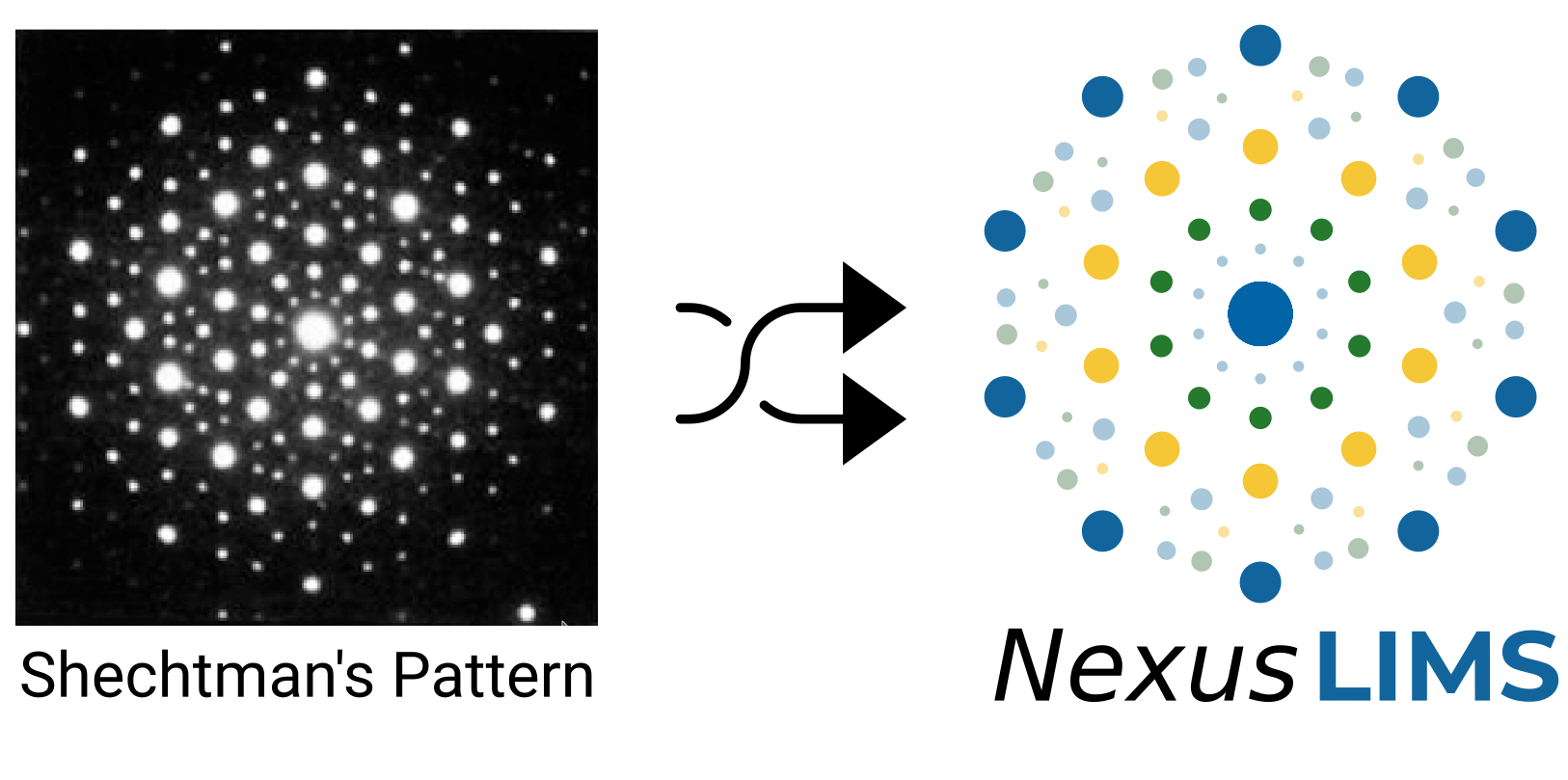
The logo for the NexusLIMS project is inspired by the Nobel Prize winning work of Dan Shechtman during his time at NIST in the 1980s. Using transmission electron diffraction, Shechtman measured an unusual diffraction pattern that ultimately overturned a fundamental paradigm of crystallography. He had discovered a new class of crystals known as quasicrystals, which have a regular structure and diffract, but are not periodic.
We chose to use Shechtman’s first published diffraction pattern of a quasicrystal as inspiration for the NexusLIMS logo due to its significance in the electron microscopy and crystallography communities, together with its storied NIST heritage:
About the developers
NexusLIMS has been developed through a great deal of work by a number of people including:
Joshua Taillon - Office of Data and Informatics
June Lau - Materials Science and Engineering Division
Marcus Newrock - Office of Data and Informatics
Ray Plante - Office of Data and Informatics
Gretchen Greene - Office of Data and Informatics
As well as multiple SURF students/undergraduate interns:
Rachel Devers - Montgomery College/University of Maryland College Park
Thomas Bina - Pennsylvania State University
Sarita Upreti - Montgomery College